
Complete wealthmanagement softwarefor family office you'realready running
 Complete wealth
Quant Wealth Manager is built for anyone whose wealth is spread across multiple custodians, entities, and asset classes. It brings all of it into one accurate view of your holdings, exposure, and returns.
See what you actually own.
A robust toolkit to manage your wealth
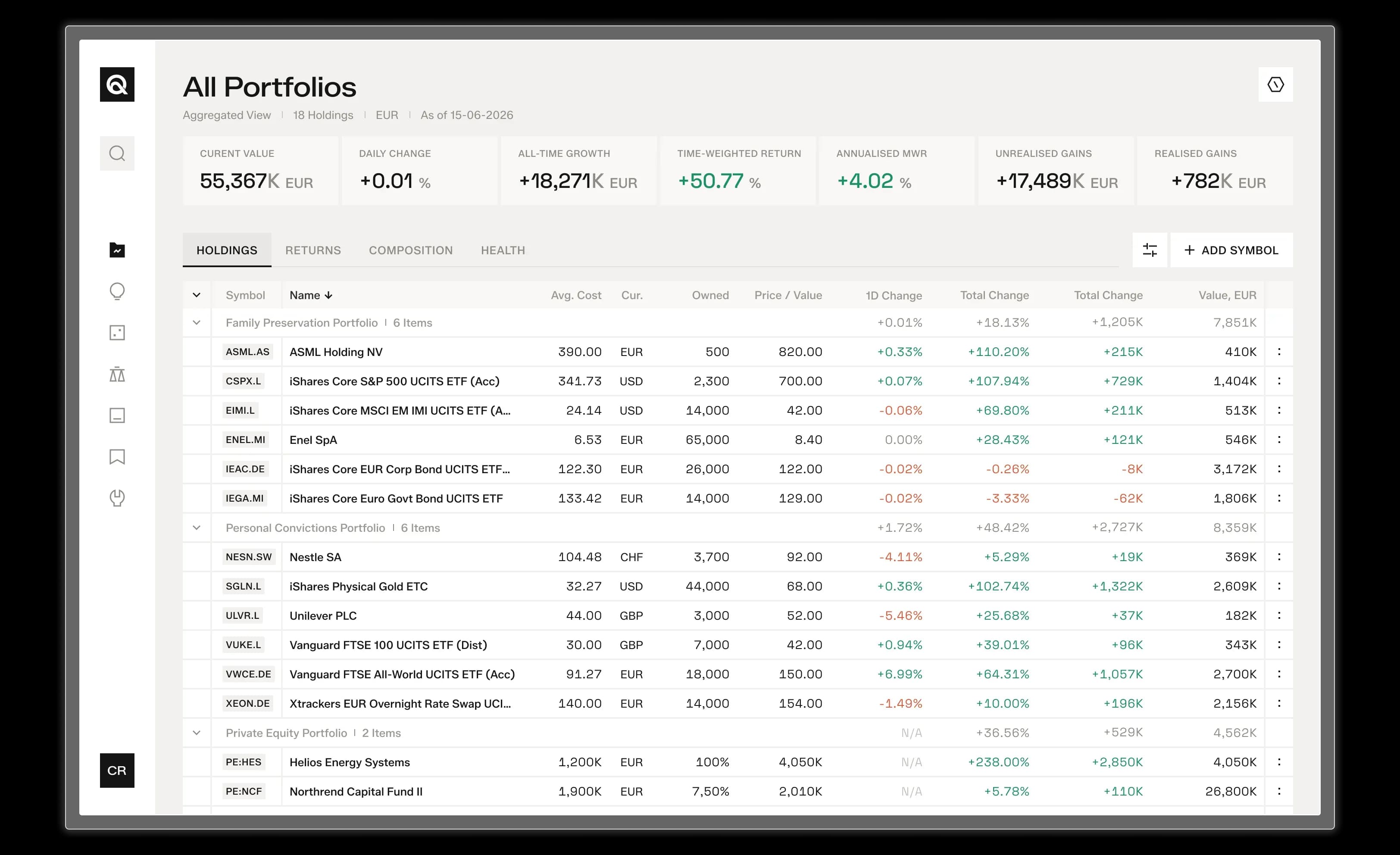
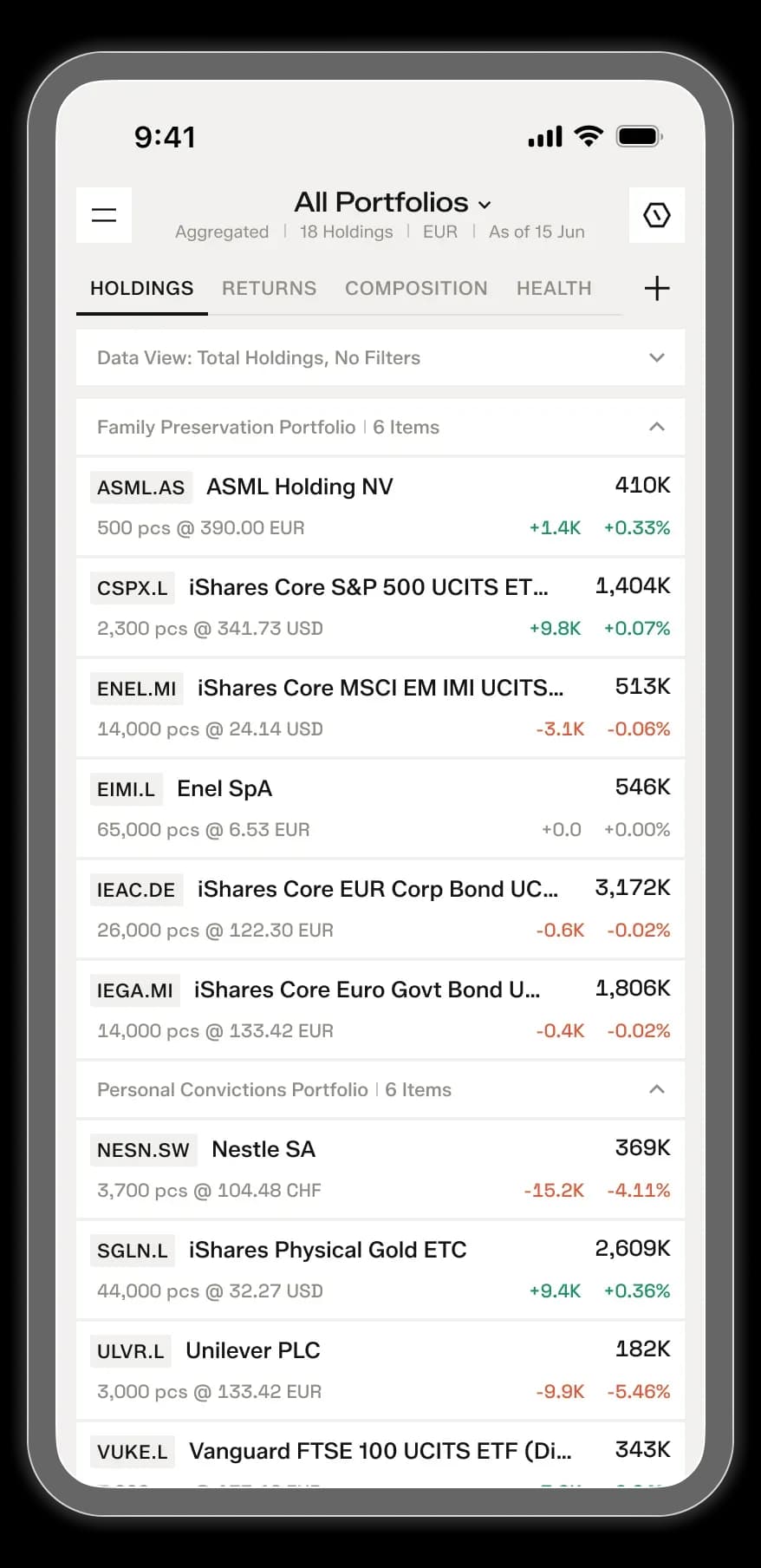
Every feature here reads from one aggregated picture of what you own, built across every custodian, entity, and account. Get that foundation right and everything downstream reconciles: returns, exposure, and the real contents of your funds.
Keep all asset types in one view
Equities, fixed income, funds, derivatives, cash, FX, and private holdings sit side by side, normalised into one consistent view. Nothing gets left behind in a spreadsheet.

| Symbol | Owned | TWR | Change | Change % |
|---|---|---|---|---|
| ASML.AS | 500 | +21.11% | +215K | +110.25% |
| CSPX.L | 2,300 | +19.08% | +729K | +107.94% |
| EIMI.L | 14,000 | +11.33% | +211K | +69.81% |
| ENEL.MI | 65,000 | +8.83% | +121K | +28.44% |
| IEAC.DE | 26,000 | -0.04% | -8K | -0.21% |
| IEGA.MI | 14,000 | -0.23% | -62K | -3.35% |
| NESN.SW | 3,700 | +0.18% | +19K | +5.27% |
| SGLN.L | 44,000 | +22.10% | +1,322K | +102.76% |
| ULVR.L | 3,000 | +9.39% | +37K | +25.64% |
| VUKE.L | 7,000 | +6.39% | +96K | +39.05% |
Review & compare returns
Quant decomposes total return into realised gains, dividends, interest, coupons, and other income, reconciled across every custodian. Returns re-aggregate by any dimension — the return of a sector, industry, or region across everything you hold, underlying fund positions included.
See your real exposures
Quant rolls real exposure up across every custodian and down every dimension you track: asset class, currency, country, sector, industry, single name. Look-through resolves what sits inside your funds.
Add custom attributes
Apply any attribute you define to any holding, then get exposures, groupings, and returns broken down along those dimensions — rolled up across custodians and through fund look-through.
| Name | Type |
|---|---|
| Conviction Level | Scale (1–10) |
| Co-Investment | Boolean |
| Insider / Restricted | Boolean |
| Investment Style | Multi Select |
| Liquidity Score | Scale (1–10) |
Look through funds and ETFs
We resolve every fund, ETF, and SMA down to its underlying holdings and reassemble them across custodians. Your composition and returns then count the shares inside each wrapper rather than the wrapper itself.

Bring your own AI
Quant exposes the platform as tools your own AI-powered tool can call. Ask Claude, ChatGPT, or Mistral about your portfolio and the numbers come straight from the same finance systems that produce your reports.









See Quant in action
Connect your custodians, feed in an Excel spreadsheet, or ask your AI to create a sample. Get true insights in minutes.
The same platform, from personal to institutional
The problems may scale up, but the method stays the same. Quant brings everything into one place and hands you the same enterprise-grade analysis tools, whether you're managing one portfolio or a hundred.

Family offices
Quant aggregates every custodian, entity, and asset class into one picture, however diverse the holdings get. Real estate, trust funds, family heirlooms, you name it. When a principal asks, the answer is already in front of you.
Learn more
Personal wealth
One place to see everything you hold, across every account and asset type. The enterprise-grade analysis tools institutions rely on are here too, working at the same level on your own portfolio. Your wealth, understood as well as any institution understands theirs.
Learn more
Advisors & consultants
One platform for all your clients, not a separate set of tools for each. Manage and analyse every portfolio in the same place, and give each one the same depth, high-touch or not. Client reviews start from numbers you can stand behind.
Learn moreFrequently asked questions
Who uses portfolio management software, and what are the main use cases?
Portfolio management software is used by financial advisors, RIAs, broker-dealers, institutional teams, operations teams, and individual investors to manage investment portfolios more efficiently. Each user group may have different priorities, from asset allocation and model portfolios to equity research, attribution tools, backtesting, and portfolio optimization.
For advisors and RIAs, the software can support client portfolio oversight, third-party model portfolios, reporting, and rebalancing workflows. Broker-dealers and institutional teams may need stronger controls around operations, research, model management, and scalable portfolio analytics. Individual investors may use these platforms to understand allocation, compare strategies, and make more informed investment decisions.
Why are data integration and analytics important in portfolio management platforms?
Data integration and analytics are important because investment teams often work with fragmented data across custodians, PMS systems, CRMs, portfolio data flows, and external market sources. A strong portfolio management platform brings this information into one governed data layer, so users work from a consistent picture instead of disconnected inputs.
Advanced investment analytics, predictive analytics, AI-powered forecasting tools, data aggregation, custodian integrations, and contextual intelligence help users better understand portfolio performance, risk, allocation, and client opportunities. When the data ecosystem is connected, teams can reduce manual work, improve decision-making, and create more reliable portfolio reporting.
What are the key features of investment portfolio management software?
Key features of investment portfolio management software often include automatic rebalancing, tax-loss harvesting, performance analytics, risk assessment, portfolio optimization, and branded client-ready reporting. These tools help users manage portfolios more consistently while giving clients or internal teams clearer visibility into performance and allocation.
More advanced platforms may support custom benchmark comparisons, exposure breakdowns by sector, asset class, region, or x-ray views, long/short and multi-sleeve models, model portfolio and report template sharing, performance charting, public and custom tickers, and risk analysis using metrics such as Sharpe ratio, Sortino ratio, beta, and drawdown. Some platforms also support manual or CSV-based rebalancing for teams that need more flexible workflows.
Why do portfolio management platforms need customization and flexibility?
Portfolio management platforms need customization and flexibility because investment strategies, client preferences, risk profiles, and reporting requirements can vary significantly. A flexible system allows teams to create custom benchmarks, custom constraints, multi-asset model portfolios, and tailored portfolio designs instead of forcing every client or strategy into the same structure.
Customization can also support asset allocation and tactical model testing, historical portfolio backtesting, Monte Carlo simulations, factor-based regression, stress testing, risk attribution, risk-return analysis, and sleeves functionality. These capabilities help investment teams test ideas, compare scenarios, and build portfolios that better match each client's goals and constraints.
How do AI and automation improve portfolio management?
AI and automation improve portfolio management by helping teams process data faster and make more systematic investment decisions. Instead of relying only on manual analysis, platforms can use computer algorithms, machine learning, quantitative models, and real-time AI analytics to support portfolio construction and monitoring.
Automation may also help with portfolio data synchronization, automated portfolio construction, AI workflows, robo-advisor functionality, advanced investment analytics, and risk profile analysis. For firms building on an AI-native wealth management platform, these tools reduce repetitive work, improve consistency, and help advisors or investors make more data-driven decisions.
What are the benefits of portfolio management software?
Portfolio management software can improve diversification, cost efficiency, operational efficiency, and decision-making by combining portfolio analytics, automation, and reporting in one system. Features such as asset allocation modeling, model portfolios, rebalancing, risk analysis, historical analysis, and Monte Carlo simulations help users evaluate portfolios more clearly and make better-informed investment decisions.
The software can also reduce manual work through automated data pipelines, custodian and PMS integrations, holdings matrices, holdings contribution tables, and client-ready reports. These capabilities help investment teams save time, reduce human bias, improve tax efficiency, and deliver more consistent portfolio oversight across accounts and clients.
How can leading portfolio management software solutions be compared?
Leading portfolio management software solutions can be compared by reviewing their asset allocation modeling, backtesting, exposure analysis, performance attribution tools, reporting capabilities, and suitability for different user needs. Some platforms are designed for individual investors or robo-advisors, while others are built for financial advisors, RIAs, institutional teams, or hybrid wealth management models.
A strong comparison should evaluate model portfolio tools, portfolio diagnostics, side-by-side portfolio comparisons, performance charts, performance metrics, proposal generation, and exposure analysis tools. The best solution depends on whether the user needs simple portfolio tracking, advisor-ready reporting, advanced analytics, automated rebalancing, or a full portfolio management platform.
Latest insights and trends
What a Balanced Investment Portfolio Actually Looks Like
Active vs Passive Investing: A Guide for Long-Term Investors
See what you actually own
Get early access and connect your custodians in minutes, or book a demo to see Quant in action on a portfolio like yours.